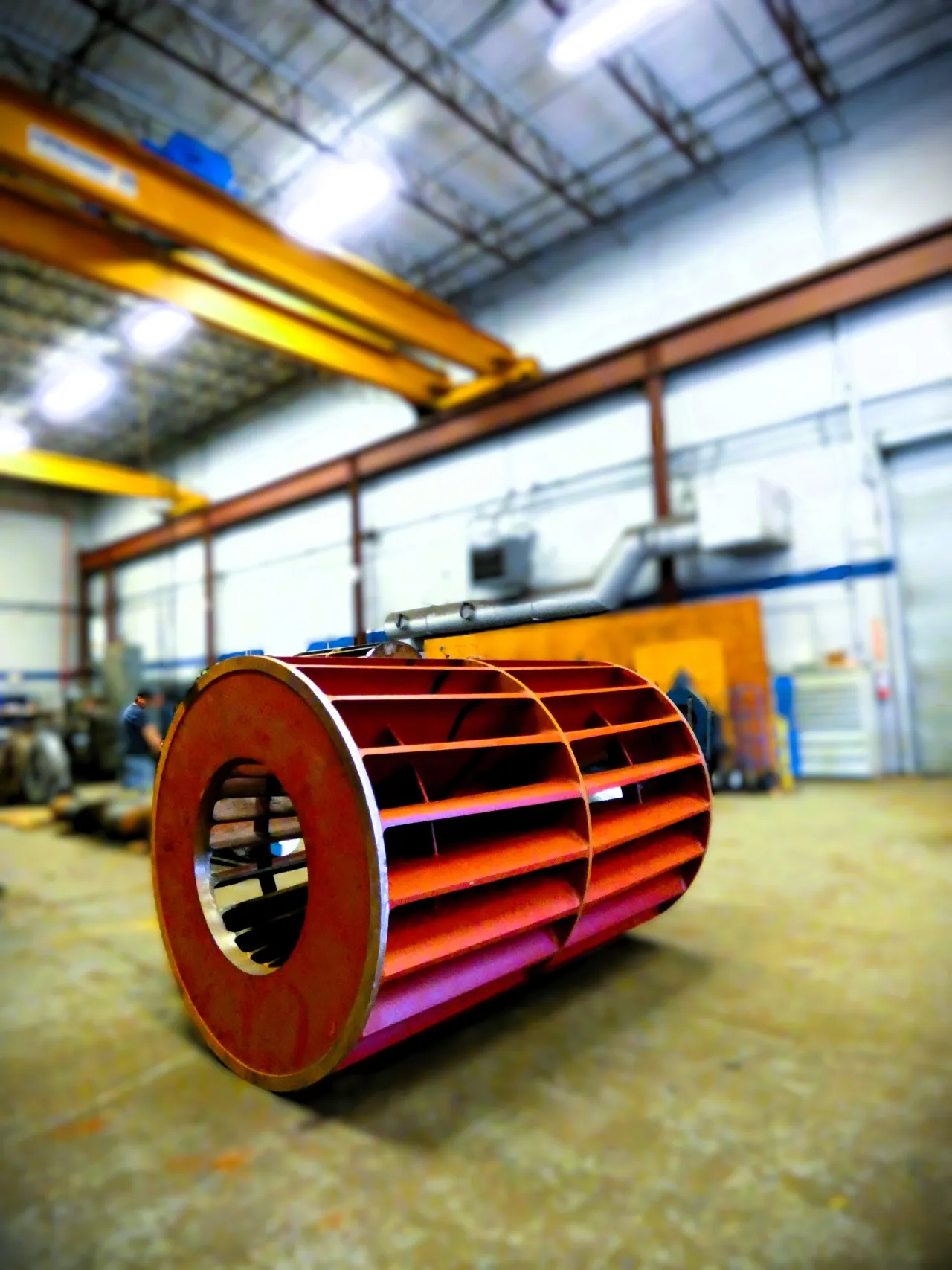
Precise Mechanical repairs, rebuilds and replaces the liquid ring vacuum pumps that dewater paper machines: the Nash® CL, 904, SC and AT series and the Somarakis® SV series that serve flat boxes, couch rolls, uhle boxes and felt conditioning. We are an independent Houston shop with 4,395 completed pump jobs since 2003, we manufacture drop-in replacements for the common mill frames, and we keep rebuilt exchange units in stock for outages. Pulp and paper is our primary industry, and mills across the Southeast, Northwest and Gulf Coast ship pumps to us.
Paper Machine Vacuum
Where Liquid Ring Vacuum Pumps Sit on a Paper Machine
Vacuum does the dewatering that gravity and the press section cannot. On a typical machine, liquid ring pumps are dedicated to zones with different vacuum levels, and the pump series tends to follow the duty.
| Machine Position | Function | Typical Vacuum Level | Series Commonly Found |
|---|
| Forming section, flat boxes |
Pull water through the forming fabric to raise sheet consistency before the couch |
Low to moderate |
CL, SC, AT |
| Couch roll |
Final forming-section dewatering through the perforated couch shell, plus sheet pickup |
Moderate to high |
CL, 904 |
| Uhle boxes |
Dewater and condition press felts so they can accept water from the sheet |
High |
CL, 904, SC |
| Felt conditioning and suction rolls |
Suction press rolls, pickup rolls and felt suction boxes |
High |
CL, 904 |
| Press section |
Suction press rolls and transfer rolls |
High |
904, CL |
A couch pump that loses capacity raises sheet moisture into the press, and a uhle box pump that fails lets the felt fill with water. Either one costs speed or costs the sheet.
Common Failure Causes
Why Vacuum Pumps Fail in Mill Service
Liquid ring pumps have one moving part and no metal-to-metal sliding contact, which is why they survive paper mill service at all. What kills them is what comes in with the air and with the seal water.
| Failure Mechanism | What We See on Teardown | Cause in the Mill |
|---|
| Seal Water Quality |
Pitting and grooving of cones and port plates, deposits in the rotor |
Recirculated whitewater or mill water carrying fiber, fines, filler and dissolved solids instead of clean seal water |
| Scale |
Hard scale on rotor shrouds and cone faces, reduced clearances, rising amps and temperature |
Calcium carbonate and other hardness in seal water precipitating in the warm liquid ring |
| Fiber and Abrasives |
Wear on cone and rotor surfaces, erosion of port openings, packing and seal damage |
Fiber and filler carried over from the boxes through the separator into the pump |
| Cavitation |
Pitting concentrated at the rotor blade tips and the discharge side of the cone |
Operating below design inlet pressure, seal water too warm, or insufficient seal water flow |
| Corrosion |
General wasting of cast iron, casing wall loss, corroded shafts under sleeves |
Low pH or high chloride mill water, sulfite or bleach plant carryover, and long idle periods |
| Mechanical |
Bearing failure, bent shafts, cracked casings |
Misalignment, water hammer on startup, foreign objects, and the wear above left uncorrected |
In practice these overlap. Scale closes clearances, the pump runs hotter, the warmer liquid ring cavitates, and the pitted cone then wears faster on the fiber coming through. Our teardown and inspection identifies the cause of failure, not just the damage, and we report it back to the mill.
Independent Repair & Manufacturing
Why an Independent Shop That Manufactures Drop-Ins Matters
Many mill pumps are decades old. When a casing on a large CL pump is cracked through or a 904 rotor is wasted beyond cladding, the question becomes whether the OEM still supports the frame and how long a new one takes.
Precise Mechanical manufactures drop-in replacement pumps for the Nash CL series from CL200 through CL14000, the 904 series (904L/M, 904P/R, 904S/T, 904U), the AT and SC series in single-cone and dual-cone configurations, and the 2BE1 and 2BE3, plus the PM 5986 line compatible with Somarakis SV and HV pumps. Drop-in means the new pump lands on the existing base and into the existing piping with minimal or no modification.
Because we are not an authorized service center, we are not bound to the original material or the original casting. We know what fails, why it fails, and how to make it better. No ties to a manufacturer, boxes to stay inside of, antiquated rules to follow, or slow and costly timelines.
120" Vertical Boring Mill Swing
240" Lathe Between Centers
400 Ton Horizontal Wheel Press
Our shop is built for the size of pump a paper mill runs. A Cincinnati vertical boring mill with a 120 in. swing, lathes to 240 in. between centers, and a 400-ton horizontal wheel press are what it takes to machine a CL14000 casing or press a rotor off a large-frame shaft. We have the machinery to repair the largest pumps in the world.
Outage Support
The Exchange Program for Mill Outages
A rebuild has a shop turnaround, and a mill in an unplanned outage does not have one to give. Our exchange program keeps rebuilt units on the shelf for the series most common in mills: CL200 through CL14000, SC2 through SC7, AT1004 through AT2006, the 904 series and Somarakis SV3028 through SV5986. We ship the rebuilt pump, the mill installs it, and the failed pump comes back to Houston as the core.
Exchange also fits a planned outage that is too short for a rebuild. Swap during the shutdown, return the core afterward, and the rebuilt core can become the mill's shelf spare.
View Exchange Program
Mill-Duty Upgrade
Stainless Steel Cladding
The most effective upgrade for a cast iron pump in mill service is stainless steel cladding of the wear surfaces. We clad cast iron cones, port plates, rotor faces and heads with 304L or 316L stainless steel, in-house, then machine the clad surface to the original OEM tolerances.
Cladding puts a corrosion-resistant surface exactly where seal water and fiber do their damage, while keeping the cast iron body and the original footprint. Where the whole component is past saving, we manufacture it new, in cast iron or with cladding applied from the start.
Cast iron repair is considered by many to be a lost art. Precise Mechanical performs these operations on a daily basis, which is why a cracked casing does not automatically mean a new pump.
Common Mill Pumps
Series Most Common in Paper Mills
Nash CL Series
The workhorse of North American paper machines, from the CL200 on small utility duty to the CL14000 on couch and uhle box service. We rebuild every frame, keep exchange units across the range, and manufacture new drop-in CL pumps.
View CL Series Repair
Nash 904 Series
Two-stage pumps used where high vacuum is needed at the couch, suction rolls and uhle boxes. Two stages mean two sets of cones and port plates to keep in tolerance, and 904 rotors are a frequent cladding candidate.
View 904 Series Repair
Nash SC & AT Series
Found on older machines and on smaller flat box and felt duties, in single-cone and dual-cone configurations. Parts for the older SC frames are often obsolete, and we reverse-engineer them.
View SC, AT & 2BE Repair
Somarakis SV Series
Large single-stage pumps on newer and rebuilt machines. We rebuild them, stock SV3028 through SV5986 exchange units, and manufacture the PM 5986 replacement line.
View Somarakis Repair
Before Shipping
What to Send With the Pump
Nameplate Data
Where It Runs on the Machine
Symptoms Before Removal
Seal Water Analysis, If Available
Ship the pump with its nameplate data, a note on where it runs on the machine, and anything the operators noticed before it came out: rising amps, vibration, loss of vacuum. A seal water analysis, if the mill has one, is worth including. Pumps ship to 2414 Black Gold Ct, Houston, TX 77073.